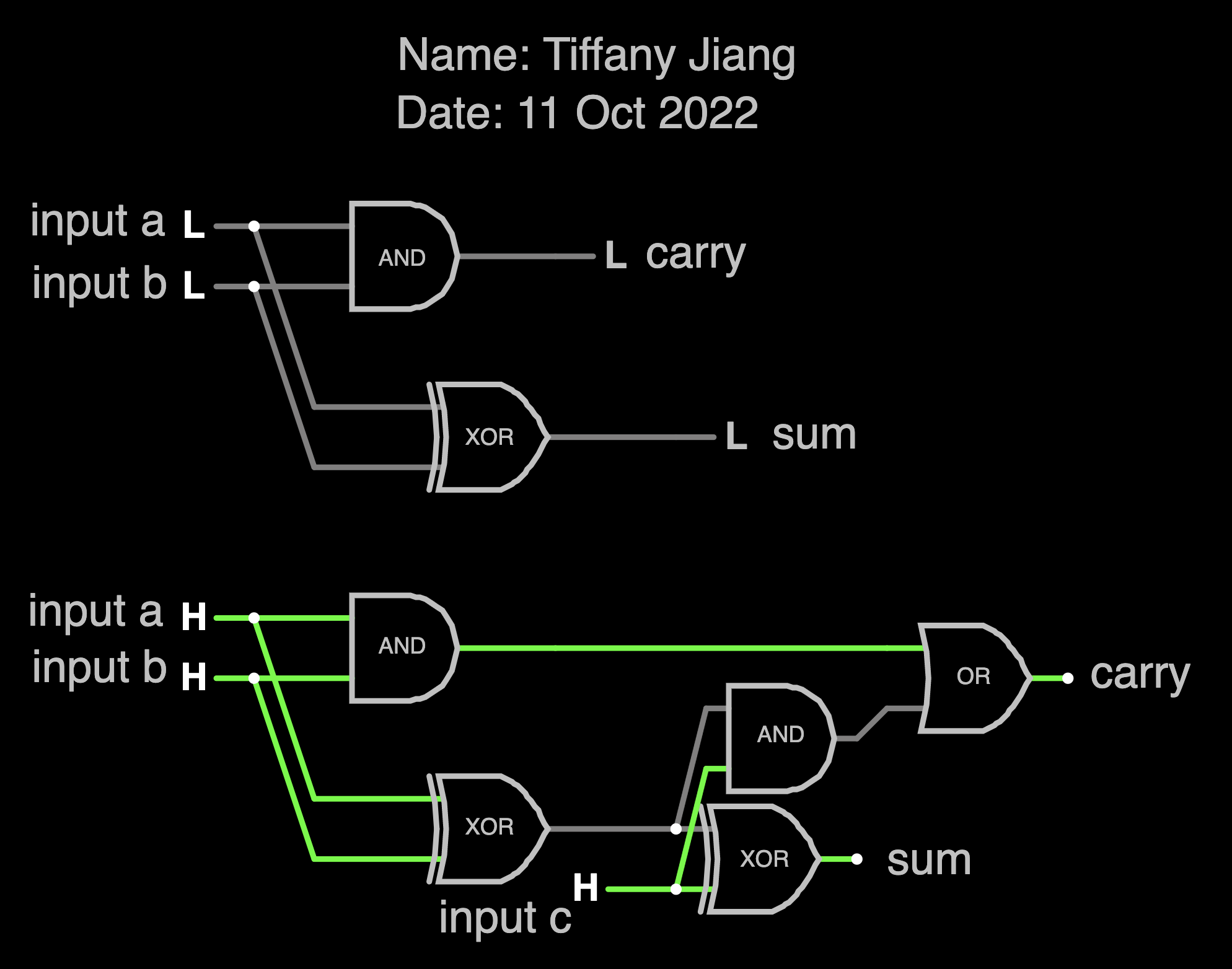
Section 1
1.1: What truth table do you recognize that produces the output of the Carry column?
The truth table of AND produces this output.
1.2: What truth table do you recognize that produces the output of the Sum column?
The XOR truth table produces the output of the Sum column.
Section 2
2.1: What do you notice about the relationship between the first-half (top four rows) of the full-adder as compared to all of the rows of the half-adder?
The outputs of the half-adder and the top four rows of the full-adder are the exact same.
2.2: Why is this true?
The a and b inputs are identical, but in the full-adder, the c-input values of the first four rows are all zeros. Thus, nothing is changed when zeroes are added.
Section 3
Why does the least significant bit position use a half-adder rather than a full-adder?
The total number of bits added together would have to be odd when the least significant bit position is a full-adder, which adds together three bits instead of the two of a half-adder.
Assume that proper inputs are applied for all bits in numbers A and B. Will the correct output from S be available instantaneously? If not, why not?
The correct output from S would be available instantaneously in with a single half-adder or full-adder, but it would not be available instantaneously from a ripple carry adder. This is because there are multiple steps to the operation that happen one after the other.
Assume that we have a standard (non-scientific calculator) capable of adding two 16-bit words. Two numbers, A and B, are added together. After the addition, it is noted that C(15) is high. What can we infer? What is this state commonly called?
This state is called overflow, where there is an extra unit of counting beyond what the calculator can represent.